What Is an Open Floor Plan?
Open layouts have dominated residential design for decades. They’re featured in modern builds, renovations, and nearly every real estate listing that wants to signal “updated.” But before you decide to remove walls or build new, you need a real answer to the question: what is an open floor plan?
An open floor plan is more than a design trend. It’s a structural decision, a mechanical systems decision, and a lifestyle decision. Done properly, it can transform how a home feels and functions. Done casually, it can create long-term inefficiencies, noise issues, and expensive retrofits.
This guide breaks it down from both an architectural and engineering perspective—so you can make an informed choice.
What Is an Open Floor Plan?
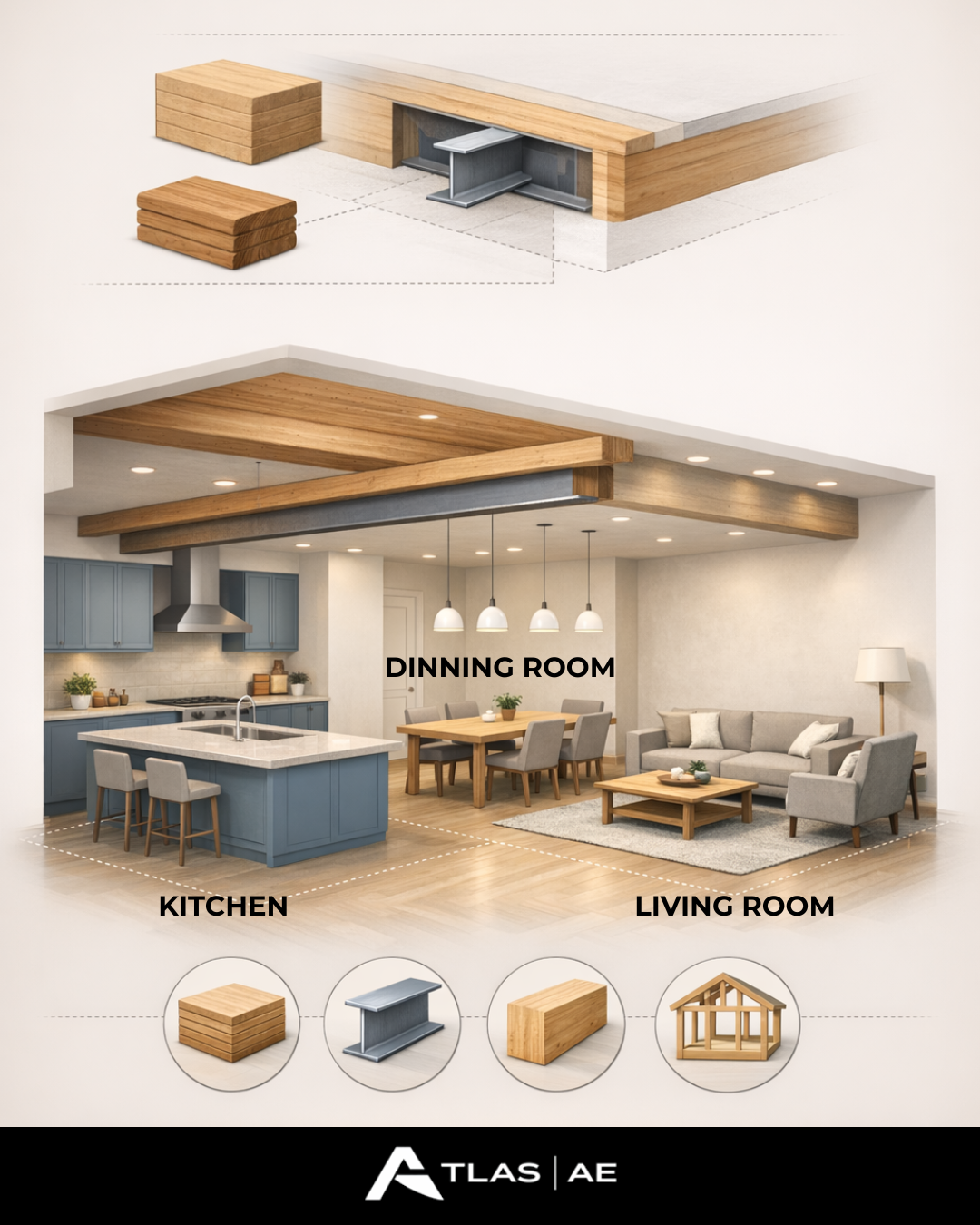
At its simplest, an open floor plan is a layout where interior partition walls between primary living spaces are removed to create one continuous area. Instead of separate rooms divided by full-height walls and doors, spaces flow into each other visually and physically.
The most common configurations in open floor plan houses include:
Kitchen + Dining
Dining + Living
Kitchen + Dining + Living (often referred to as a “Great Room”)
In an open concept floor plan, subtle divisions may still exist. Kitchen islands, ceiling treatments, flooring transitions, or partial-height walls often define zones without fully enclosing them.
Here’s the critical clarification: open does not mean structureless.
When walls are removed, the loads they carried must be redistributed. In modern construction, that redistribution is handled through engineered structural systems such as:
Laminated Veneer Lumber (LVL) beams
Steel I-beams
Glulam (glued laminated timber) beams
Moment frames in larger-span designs
The openness you see is supported by hidden structural precision.
Open Floor Plan vs Closed Layout
The debate around open floor plan vs closed layouts is often emotional, but the differences are architectural and functional.
| Feature | Open Floor Plan | Closed Floor Plan |
|---|---|---|
| Structure | Beam-supported wide spans | Multiple load-bearing walls |
| Acoustics | High sound transmission | Compartmentalized |
| HVAC Control | Requires careful zoning | Easier room-by-room control |
| Privacy | Limited | High |
| Resale Appeal | Broad suburban demand | Growing niche appeal |
Open layouts prioritize connection and visual scale. Closed layouts prioritize separation and control. Neither is universally superior—the right choice depends on how the home is used
The Structural Engineering Behind an Open Concept Floor Plan
Most articles stop at décor. The real conversation starts with structure.
Load-Bearing Wall Removal
Not every wall can be removed. Load-bearing walls support floor joists, roof loads, or upper stories. Removing one without proper reinforcement compromises structural integrity.
To determine feasibility, you must evaluate:
Framing type (platform vs balloon framing)
Roof structure (stick-framed vs truss systems)
Direction of floor joists
Load path from roof to foundation
Platform framing, common in modern homes, builds each floor as a separate platform. This makes structural modification more predictable.
Balloon framing, found in older homes, uses continuous studs from foundation to roof. Altering these structures is significantly more complex and often impacts multiple floors.
Truss roof systems introduce additional considerations. Interior walls sometimes provide bracing rather than load-bearing support. Removing them requires structural verification.
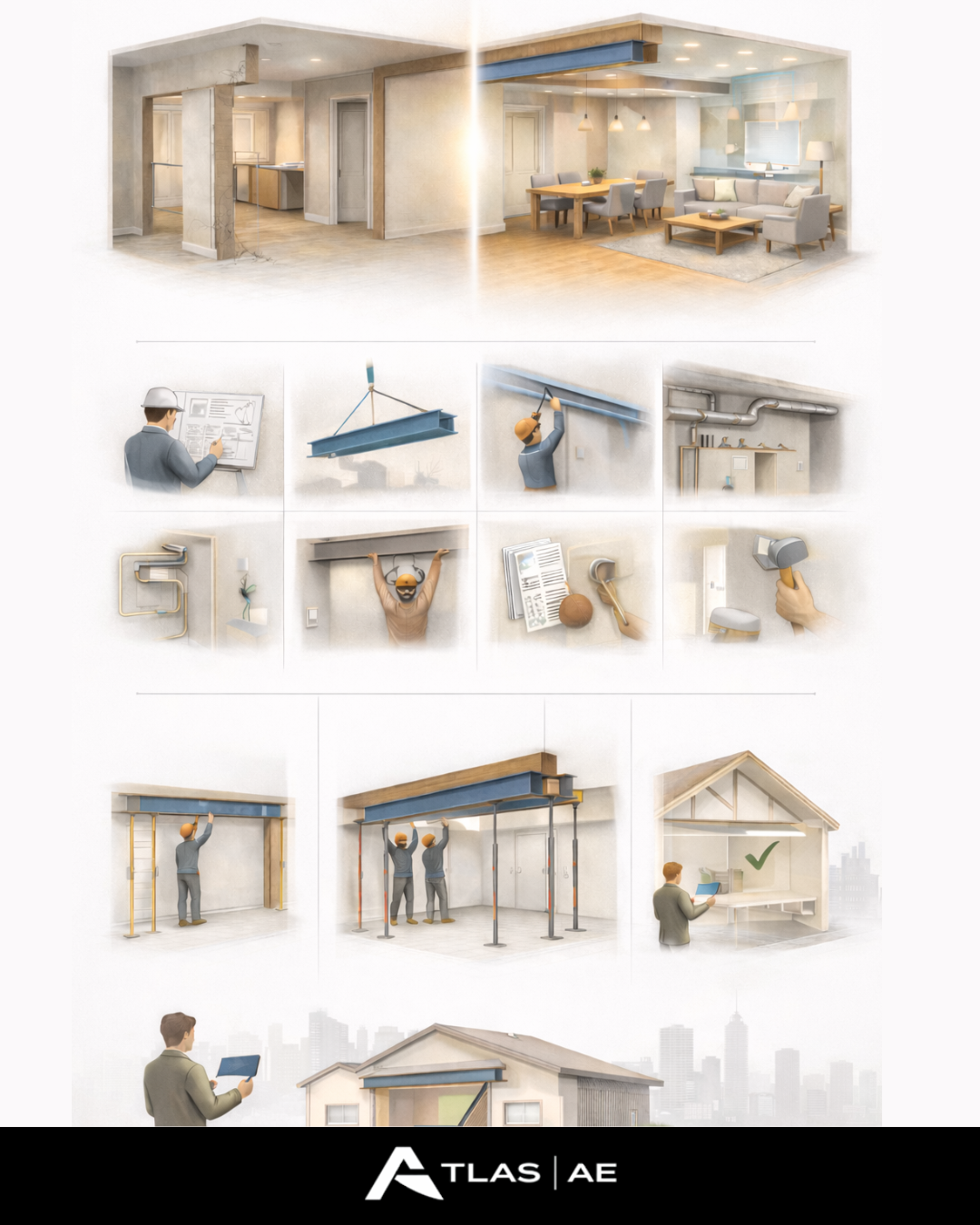
DIY wall removal often fails inspection because homeowners underestimate temporary shoring, beam sizing, or foundation load transfer.
Beam Sizing and Span Limits
Residential open floor plan layouts typically span between 12 and 24 feet. Beam sizing depends on:
Tributary load area
Live and dead loads
Span distance
Deflection limits
Residential floors are commonly designed to an L/360 deflection standard. Excessive deflection results in cracking drywall, uneven floors, and long-term structural movement.
LVL beams are often used for moderate spans and are cost-effective. Steel beams allow longer spans with slimmer profiles but increase installation complexity and cost.
Importantly, beams transfer load to columns. Columns transfer load to foundations. If point loads exceed footing capacity, reinforcement or underpinning may be required.
Foundation Implications
Open concept retrofits often concentrate loads into smaller areas. Many basement slabs are not designed to support structural columns.
Before altering an older home, consider:
Whether new footings are required
Whether foundation walls can support added loads
Whether underpinning is necessary
Foundation oversight is where budgets expand quickly.
Mechanical, Electrical, and HVAC Impacts
An open floor plan layout affects mechanical systems significantly.
Larger volumes increase heating and cooling demand. Higher ceilings and expanded spaces require recalculating BTU requirements.
Wall removal may require:
Duct relocation
Return air redesign
Thermostat repositioning
Electrical circuit extensions
Smoke detector relocation
Without proper HVAC zoning, open layouts often experience uneven temperatures and airflow imbalance.
Lighting design must also evolve. Large volumes require layered lighting strategies that combine ambient, task, and accent lighting to avoid harsh or uneven illumination.
Acoustic and Privacy Considerations
Open floor plan houses allow sound to travel freely. That includes:
Kitchen appliances
Range hoods
Dishwashers
Televisions
Conversations
Traditional walls act as sound barriers. Open layouts remove those buffers, lowering overall sound isolation.
Solutions include:
Acoustic ceiling treatments
Upholstered furniture and rugs
Soft wall finishes
Glass partitions
Pocket doors for flexible separation
Noise control is one of the most commonly underestimated downsides of open layouts.
Are Open Floor Plan Houses Still Popular?
Yes—but the design is evolving.
Open layouts remain dominant in suburban new construction, particularly in homes under 2,500 square feet. They maximize perceived space and encourage social interaction.
However, post-2020 shifts toward remote work have increased demand for hybrid designs. Homeowners now seek partial separations, flex rooms, sliding panels, and adaptable enclosures.
The trend is not disappearing—it’s maturing.
When an Open Floor Plan Makes Sense
An open concept floor plan works especially well when:
The home is modest in square footage
Entertaining is a priority
Families have young children
The design is integrated into new construction
In new builds, structural planning can accommodate openness efficiently from the start.
When It Doesn’t
Open layouts may not be ideal when:
Quiet workspaces are essential
Multi-generational living requires separation
Energy efficiency in colder climates is a priority
Traditional architectural character is desired
Visual openness amplifies activity and sound. For some households, that becomes overwhelming.
Can You Create an Open Floor Plan in an Older Home?
Yes, but feasibility determines cost.
Typical retrofit expenses may include:
Structural engineering fees
Beam fabrication and installation
Permit costs
Electrical and HVAC adjustments
Finish restoration
Depending on region and complexity, beam installation alone can range from several thousand to tens of thousands of dollars.
In many municipalities, stamped structural drawings and inspections are mandatory. Always consult local building codes and permitting requirements before starting.
Designing a Functional Open Floor Plan Layout
Successful open layouts rely on intentional architectural decisions.
Sightlines should be controlled so that every angle does not expose clutter. Ceiling plane articulation—such as beams or subtle height shifts—can define zones. Kitchen islands serve as spatial anchors and natural dividers. Flooring continuity enhances visual flow, while lighting layers create warmth and hierarchy.
The goal is cohesion without chaos.
Is an Open Concept Floor Plan Right for You?
The answer depends on:
How you use your home daily
Whether you work remotely
Your tolerance for noise
Your structural budget
Your long-term resale strategy
An open floor plan is not automatically superior. It is powerful when aligned with lifestyle and engineered correctly.
Before removing walls or committing to a layout, evaluate structure first, aesthetics second.
Final Thoughts
Understanding what is an open floor plan requires looking beyond visual appeal. It involves structural engineering, mechanical system planning, acoustic foresight, and long-term functionality.
When designed with intention, an open concept floor plan creates connection and light. When implemented without planning, it introduces complexity and compromise.
If you’re considering modifying your home or building new, start with structural evaluation and system analysis before making design commitments.
