Average Dining Room Size
A dining room that’s too small feels cramped. Too large, and it feels disconnected. The average dining room size isn’t just a number — it directly impacts comfort, circulation, and how your home functions day to day.
Whether you're building new, renovating, or rethinking your current layout, this guide breaks down real architectural measurements, seating formulas, and layout strategies so you can plan with confidence — not guesswork.
You’ll learn:
The average dining room size in feet by home type
Proper clearance standards architects use
Ideal dimensions for 6- and 8-person tables
How open-plan layouts change sizing requirements
A practical planning formula you can apply immediately
Let’s design this properly.
What Is the Average Dining Room Size?
The average dining room size in U.S. residential homes typically ranges between 12’ × 12’ (144 sq ft) and 14’ × 16’ (224 sq ft).
However, that number only tells part of the story.
The true “average” depends on how the room functions — not just its footprint. Two dining rooms may share identical square footage but feel dramatically different depending on furniture scale, circulation clearance, and ceiling height.
In residential architecture, dining rooms are sized based on three primary spatial drivers:
Seating capacity (number of regular diners + occasional guests)
Table dimensions and shape
Required circulation clearance around the table
Beyond those basics, layout conditions significantly affect perceived and functional size:
Whether the room is enclosed or open-plan
Proximity to kitchen islands and work zones
Door swing clearances
Structural grid or column placement
Adjacency to living areas
Inclusion of secondary furniture (buffets, hutches, bar carts)
For example, a 12’ × 12’ enclosed dining room can feel balanced and efficient for six people.
The same footprint in an open-plan layout may feel tight once cross-traffic is introduced.
Older homes built before 1990 frequently feature dining rooms closer to 11’ × 11’, reflecting more formal but smaller-scale table dimensions common in mid-century planning.
Modern construction trends have shifted toward slightly larger dining areas — especially in suburban homes — to accommodate larger rectangular tables and more casual circulation patterns.
Average Dining Room Size in Feet by Home Type
| Home Type | Typical Dining Room Size |
Square Footage |
|---|---|---|
| Small Home / Townhouse | 10’ x 10’ – 12’ x 12’ | 100–144 sq ft |
| Mid-Size Suburban Home | 12’ x 14’ – 14’ x 16’ | 168–224 sq ft |
| Large / Custom Home | 14’ x 18’ – 16’ x 20’ | 252–320 sq ft |
In contemporary open-plan homes, the dining area may not be a defined “room,” but the allocated zone still typically falls within these dimensional ranges once proper circulation clearance is accounted for.

Typical Dining Room Size By Home Type
Dining Room Size for 6 Person Table
One of the most searched questions online is: What size dining room do I need for six people?
The reason this question is so common is simple — six seats represent the most typical household configuration. It’s large enough for family dinners and small gatherings, yet compact enough for most residential floor plans.
However, the correct answer isn’t just about fitting a table. It’s about ensuring that the space feels comfortable, balanced, and functional under daily use.
Standard 6-Person Table Dimensions
A six-person table typically falls within these ranges:
Rectangular: 60”–72” long × 36”–40” wide
Round: 48”–60” diameter
The rectangular format is the most common in modern homes because it aligns efficiently with room geometry and wall placement. Round tables are better suited for square rooms and can improve conversational intimacy, but they often require slightly more surrounding clearance due to curved circulation.
For comfortable seating, allow 24–30 inches of table width per person.
24 inches per person = tight but workable
28 inches per person = comfortable for everyday use
30 inches per person = relaxed entertaining
This per-person width ensures elbow room and prevents overcrowding during meals.
Clearance Requirements
Clearance is what determines whether a dining room feels functional or cramped.
Architectural planning standards generally recommend:
36” minimum from table edge to wall
42” preferred for comfortable circulation
48” recommended on primary service or traffic sides
The difference between 36” and 42” may sound minor on paper, but spatially it changes how the room performs.
This clearance allows:
Chairs to pull out fully without hitting walls
Guests to pass behind seated diners without interruption
Smooth traffic flow between dining, kitchen, and adjacent areas
In open-plan dining room layouts, where circulation often cuts through the dining area, the 42”–48” range becomes significantly more important.
Room Dimension Formula (Example)
Rather than guessing, you can calculate the required room size using a simple architectural formula.
For a 72” × 40” table with 42” clearance:
Length:
72” + 42” + 42” = 156” → 13’
Width:
40” + 42” + 42” = 124” → 10’4”
This gives you the minimum footprint required to support comfortable movement on all sides.
If one side of the table backs against a wall (common in small dining rooms), you can reduce clearance on that side — but this reduces flexibility and everyday comfort.
Recommended Dining Room Size for 6 Person Table
Based on real-world residential layouts:
Minimum workable: 12’ × 12’
Comfortable: 12’ × 14’
Gracious: 14’ × 14’
A 12’ × 12’ room will function properly with careful furniture selection.
A 12’ × 14’ room allows better sideboard placement and circulation.
A 14’ × 14’ room begins to feel proportionally generous without being oversized.
If you plan to use extension leaves, increase clearance calculations accordingly — extended tables can quickly add 18–24 inches to overall length.
Dining Room Size for 8 Person Table
An eight-person dining configuration moves the room from “family functional” into “entertaining scale.”
This is where proportion errors become more noticeable. An undersized room paired with a large table is one of the most common planning mistakes in residential design.
Standard 8-Person Table Dimensions
Typical dimensions include:
Rectangular: 84”–96” long × 40”–44” wide
Round: 60”–72” diameter
Rectangular tables are most efficient for eight seats because they distribute seating evenly along long edges. Round tables that seat eight require significant diameter and often demand more surrounding space than homeowners anticipate.
Allow 24–30 inches per person along long edges. For comfortable entertaining, aim closer to 28–30 inches per diner.
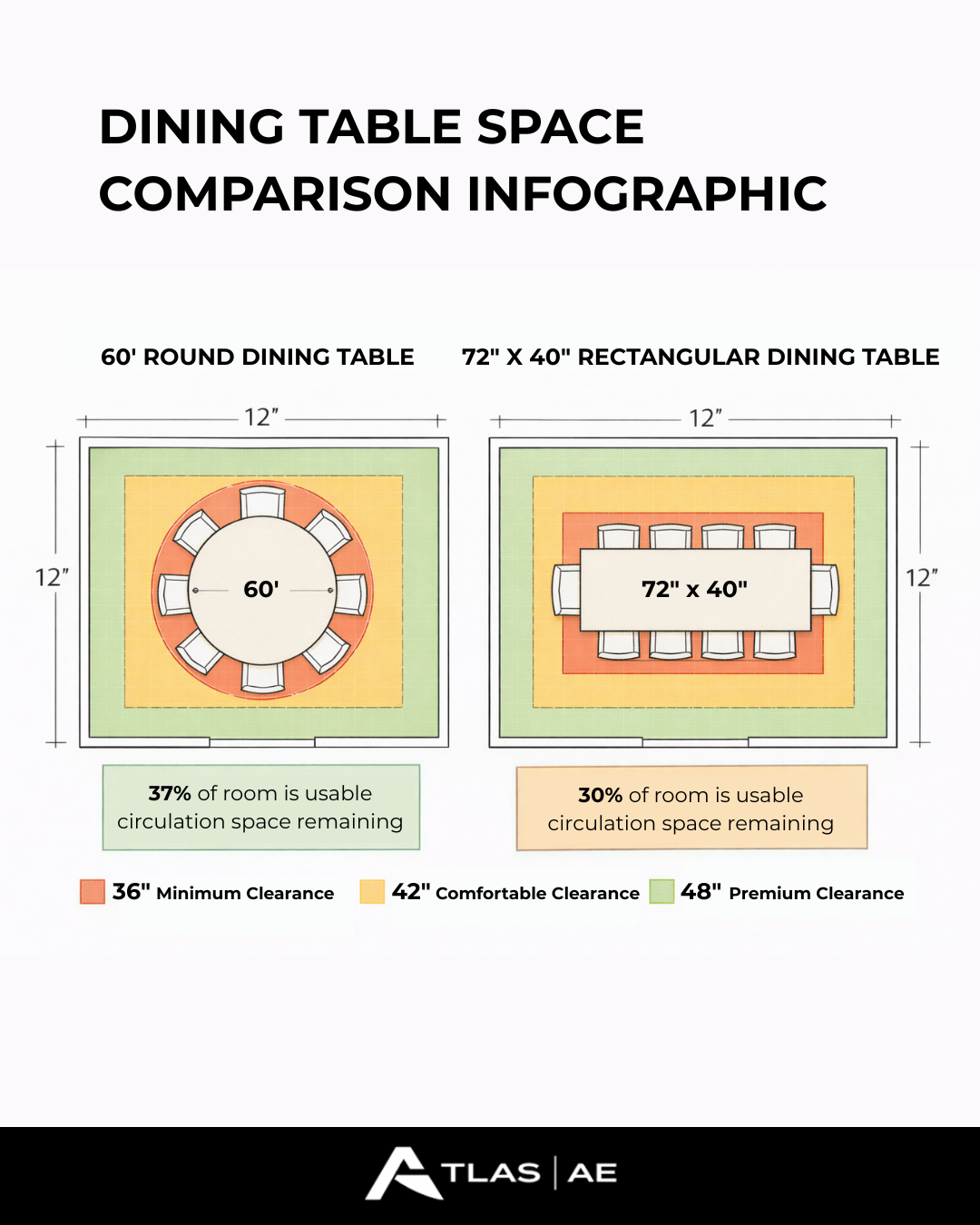
Dining Table Space Comparing - Infographic
Clearance Requirements for 8-Person Layouts
Because the table length increases, circulation becomes more critical.
For a 96” table:
Length Calculation:
96” + 48” + 48” = 192” → 16’
Width Calculation:
44” + 42” + 42” = 128” → 10’8”
Notice how quickly the required footprint expands.
In many suburban homes, an 8-person dining room size for 8 person table realistically requires:
Minimum workable: 13’ x 16’
Ideally 14’ × 18’
Luxuriously 16’ × 18’ or larger
Anything smaller often forces compromises in clearance or chair spacing.
Functional Considerations Beyond Dimensions
An 8-person dining room must also accommodate:
Sideboard depth (typically 18–20”)
Door swing clearance
Cross-traffic in open-plan layouts
Visual balance between table and ceiling height
In rooms under 9’ ceiling height, large tables can feel visually dominant. Ceiling proportion plays a subtle but important role in perceived spaciousness.
When to Choose 6 vs 8 Seats
If your room measures:
Under 12’ wide → six seats are usually optimal
14’ or wider → eight seats become practical
16’+ wide → eight seats feel balanced
Trying to “force” eight seats into a 12’ wide room is one of the most common layout mistakes in residential renovations.
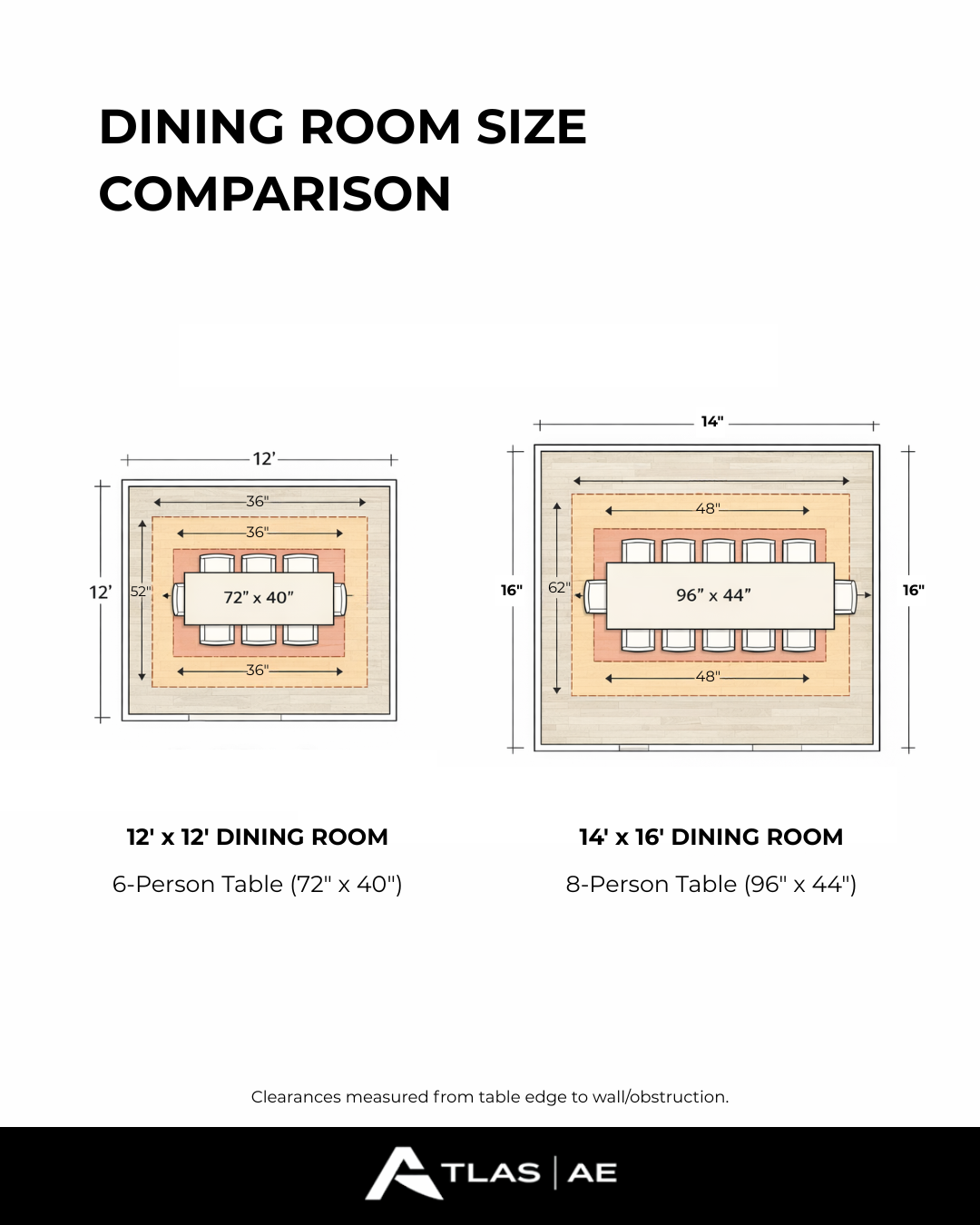
Comparing Dining Room Size
Dining Room Layouts: Architectural Considerations
Dimensions alone don’t guarantee a functional space. A dining room can technically “fit” a table yet still feel awkward, cramped, or disconnected. The difference lies in layout.
Dining room layouts influence:
Circulation patterns
Furniture proportion
Lighting placement
Acoustic behavior
Visual balance within the home
The same square footage performs very differently depending on whether the room is enclosed or part of an open-concept plan.
Enclosed Formal Dining Room
An enclosed dining room provides the most controlled planning environment. Because the space is bounded by walls, proportions are easier to manage and furniture placement is more predictable.
In traditional residential architecture, enclosed dining rooms were intentionally proportioned to center a table beneath a chandelier, with symmetrical wall spacing and clear zones for secondary furniture.
Why enclosed rooms are easier to design:
Chandelier centering is straightforward. The fixture aligns cleanly with both the table and ceiling geometry.
Acoustic containment is stronger. Walls absorb and contain sound, making conversation more comfortable during gatherings.
Furniture placement is defined. Walls anchor buffets, hutches, and display cabinetry.
Traffic flow is controlled. Entry points are typically limited to one or two doorways.
Because the room functions as a destination rather than a pass-through zone, clearance requirements are more predictable.
Recommended Ceiling Height
For proper proportion:
8’6”–9’ minimum for most enclosed dining rooms
9’ or higher preferred for rooms over 14 feet long
Rooms with lower ceilings can feel compressed when paired with larger 8-person tables. Ceiling height contributes significantly to perceived spaciousness — a factor often overlooked in basic dimension guides.
Enclosed layouts reward symmetry and controlled proportion.
Open Concept Dining Area
Open concept dining areas are visually expansive — but more complex to plan correctly.
When a dining area shares space with a kitchen and living room, it becomes part of a circulation network rather than a contained zone. This changes everything.
In open layouts, dining space must accommodate:
Movement between kitchen work zones
Passage to patios or exterior doors
Circulation behind living room seating
Interaction with island overhang seating
Structural columns or beam drops
Unlike enclosed rooms, open-plan dining areas rarely have four usable walls. That reduces anchoring opportunities and increases spatial negotiation.
Why Open Layouts Need More Width
Cross-traffic is the key driver.
In an enclosed room, circulation typically stops at the dining boundary.
In an open plan, circulation often cuts through it.
That’s why open dining areas generally require:
2–3 additional feet of width compared to enclosed rooms supporting the same table size.
Without that extra width, clearance zones collapse quickly — especially when chairs are occupied.
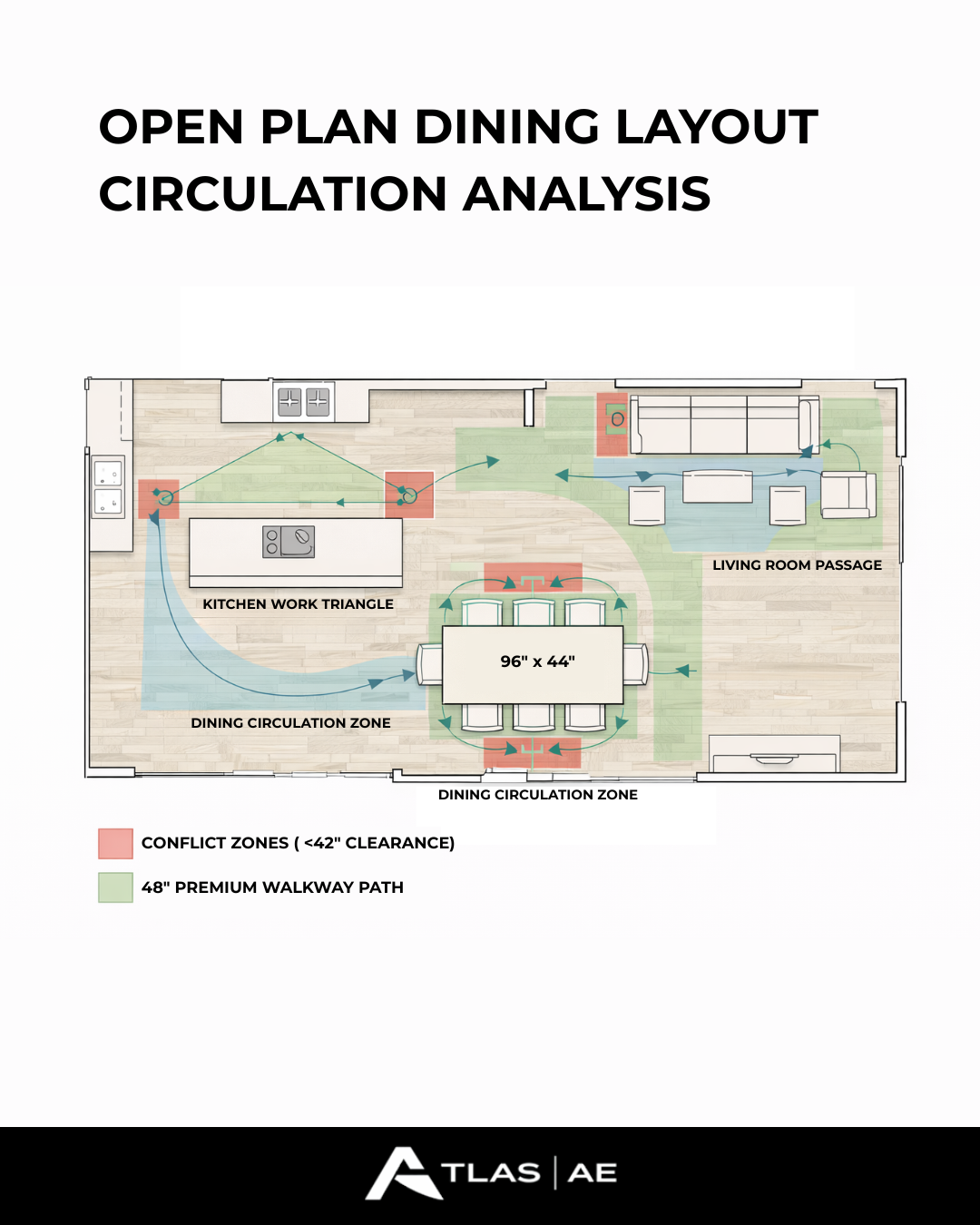
Open Plan Dining Layout Circulation Analysis
Clearance Standards Architects Use
Clearance is the invisible factor that determines whether a dining room feels refined or restrictive. Two rooms can share the same square footage yet feel dramatically different depending on how circulation space is handled.
Professional residential design relies on tested clearance benchmarks — not guesswork.
Here are the core spatial standards used in architectural planning:
| Condition | Minimum | Preferred |
|---|---|---|
| Table to Wall | 36″ | 42″–48″ |
| Walkway Behind Seated Person | 42″ | 48″ |
| Door Swing Path | 36″ clear | 42″ |
These numbers are not decorative guidelines. They are functional thresholds.
Why 36 Inches Is the Absolute Minimum
At 36 inches from table edge to wall:
A chair can pull out.
A person can slide past — barely.
The room technically works.
But it feels tight when fully occupied. The moment two people try to pass each other, friction occurs.
Thirty-six inches is “functional compliance.”
It is not comfort.
Why 42 Inches Changes the Experience
At 42 inches:
Guests can walk behind seated diners without disrupting conversation.
Chairs clear walls more naturally.
Movement feels fluid instead of negotiated.
The additional six inches may seem minor on paper, but spatially it reduces tension.
In practice, most well-designed homes aim for at least 42 inches wherever possible.
Why 48 Inches Feels Effortless
Forty-eight inches moves a dining room from functional to gracious.
This width allows:
Two people to pass comfortably.
Service flow during gatherings.
Natural, unforced movement patterns.
In higher-end custom homes, 48-inch clearance is common on primary circulation sides of the table.
The psychological difference between 36” and 48” clearance is significant. At 36”, the room feels “carefully arranged.” At 48”, it feels effortless.
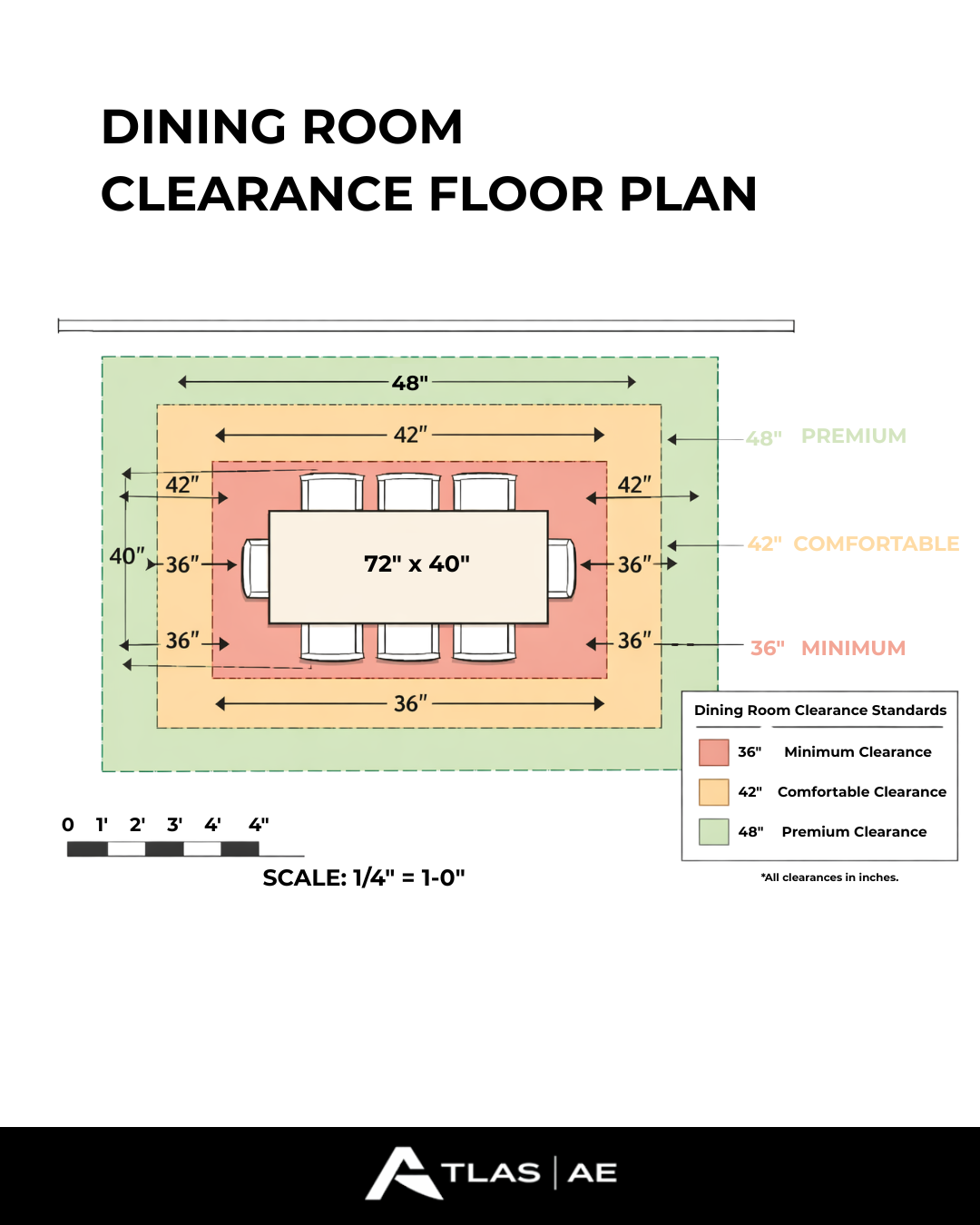
Dining Room Clearance Floor Plan
Minimum vs Comfortable vs Luxury Dining Rooms
Square footage alone does not define quality. The same 12’ × 12’ room can feel compact or balanced depending on how aggressively furniture fills the footprint.
Below is a performance-based breakdown rather than just dimensional categories:
| Tier | Typical Dimensions | Experience |
|---|---|---|
| Compact | 10’ x 10’ | 4–6 seats, tight |
| Standard | 12’ x 12’ | 6 seats, functional |
| Family Home | 14’ x 16’ | 8 seats, comfortable |
| Custom / Estate | 16’ x 20’+ | 10–12 seats |
But the tier isn’t defined only by length and width. It’s defined by circulation generosity.
Compact (10’ × 10’)
Works best with:
Round table
Wall-backed seating
Minimal secondary furniture
Clearance often hovers near 36 inches. Usable, but spatially compressed.
Standard (12’ × 12’)
The most common average dining room size in mid-size homes.
Supports:
6-person rectangular table
Balanced chandelier placement
Some flexibility in chair movement
When designed with 42-inch clearance, it performs comfortably.
Family Home (14’ × 16’)
This is where eight-person tables begin to feel proportionally correct.
The room can accommodate:
Sideboard or buffet
Larger rug footprint
More forgiving circulation
The difference is noticeable. Movement no longer feels negotiated.
Custom / Estate (16’ × 20’+)
These rooms support:
10–12 person tables
48-inch clearance or greater
Secondary seating zones
Strong ceiling height proportion (9’–10’+)
At this scale, circulation is effortless. The space accommodates gatherings without spatial tension.
The Psychological Shift
The most overlooked aspect of clearance is emotional perception.
When clearance drops below 40 inches:
Guests become spatially aware.
Chairs bump.
Movement interrupts conversation.
When clearance reaches 48 inches:
People stop thinking about space.
Circulation becomes intuitive.
The room feels calm.
This is the difference between “tight but workable” and “quietly luxurious.”
Ceiling Height & Proportion
Room proportions matter just as much as floor dimensions. In fact, many dining rooms that technically meet the “average dining room size” feel off — not because of width or length, but because of vertical imbalance.
A dining room is a volume, not just a footprint.
When ceiling height is out of proportion with table scale, lighting, or wall length, the space can feel compressed, top-heavy, or visually awkward — even if clearance standards are met.
Recommended Ceiling Heights by Room Size
The relationship between ceiling height and room width should feel balanced. Here’s how architects typically think about it:
Under 12’ × 12’ rooms:
An 8’ ceiling is acceptable and proportionally appropriate. Larger ceiling heights can sometimes make compact rooms feel cavernous or disconnected from the table scale.Rooms 14’ × 16’ and above:
A 9’ minimum ceiling is strongly recommended. Larger tables require visual breathing room above them.Large entertaining rooms (16’ × 18’+):
10’–12’ ceilings create a sense of proportion and formality. At this scale, an 8’ ceiling can make the room feel horizontally stretched and vertically compressed.
In residential design, proportion isn’t just mathematical — it’s perceptual. A well-proportioned room “feels right” immediately.
Lighting Proportion Rules
Lighting is where proportion errors become obvious.
A chandelier that’s too small makes a large dining table feel heavy.
A fixture that’s too large overwhelms the room.
Two professional rules help avoid imbalance:
Chandelier height:
Hang 30”–36” above the tabletop surface.
This keeps sightlines clear while maintaining visual intimacy.Fixture diameter:
Approximately ½ to ⅔ of the table width.
For a 40” wide table, a fixture between 20”–26” in diameter is typically ideal.
Ceiling height affects this relationship. In rooms over 9’ tall, the vertical drop from ceiling to fixture must feel intentional — not stretched.
Improper proportions can make even a correctly sized dining room feel visually unstable. The table and chandelier should read as a single composed element within the room volume.
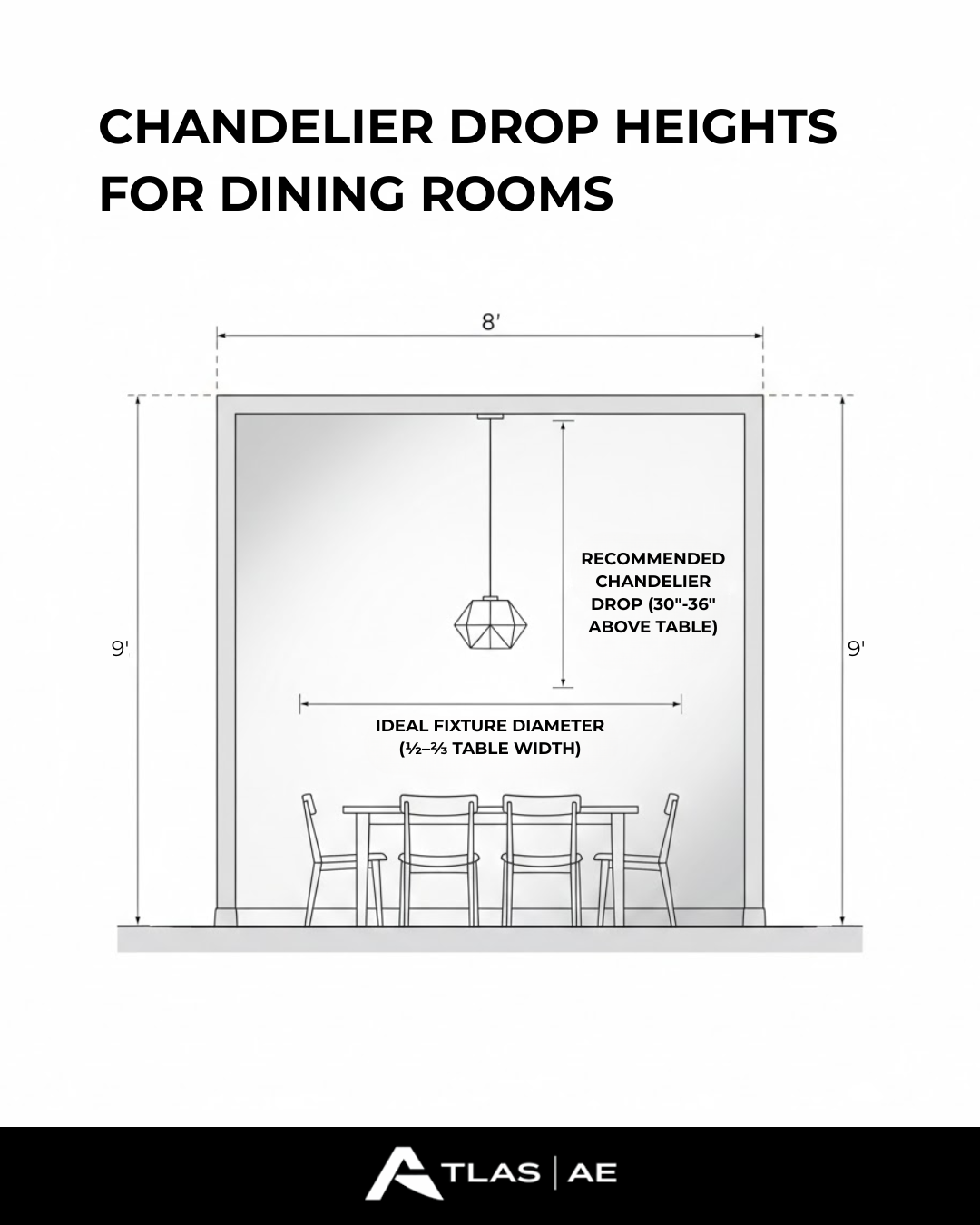
Chandelier Drop Heights For Dining Rooms
Vertical Scale & Psychological Comfort
Humans subconsciously read vertical proportion.
Low ceilings + large tables = compression
Tall ceilings + small fixtures = disconnection
Balanced ceiling + centered lighting = calm
If the room feels tense but you can’t identify why, ceiling proportion is often the culprit.
Structural & Renovation Constraints
When planning a dining room in a new build, dimensions are flexible. When remodeling, they are not.
Structural realities often dictate what’s possible long before furniture is selected.
Ignoring these constraints leads to compromised layouts and expensive revisions.
Load-Bearing Walls
Load-bearing walls define the structural grid of the home. Removing them to expand a dining room requires engineered beams, columns, or structural redesign.
Even when removed, beam depth often reduces ceiling height in the affected zone.
This directly impacts chandelier placement and perceived proportion.
Beam Depth & Ceiling Drops
Structural beams can:
Reduce ceiling height locally
Create visual breaks above the table
Limit fixture centering
A dropped beam over a dining table is one of the most common renovation compromises. While sometimes unavoidable, it changes the vertical reading of the room.
HVAC & Mechanical Interference
In existing homes, HVAC trunk lines often run through ceiling cavities in dining areas.
This can:
Prevent ideal chandelier placement
Force lighting off-center
Reduce ceiling depth in remodels
Relocating mechanical systems is possible — but costly.
Planning around them intelligently preserves budget and proportion.
Columns & Usable Width
In open-plan renovations, structural columns frequently appear once walls are removed.
While square footage may remain unchanged, columns reduce usable width and disrupt circulation flow.
A room measured at 14’ wide may effectively perform like 12’ once a column interrupts clearance zones.
This is why experienced designers measure usable clearance, not just wall-to-wall dimension.
The Mid-Century Constraint Reality
Many homes built before 1990 — especially mid-century properties — were designed around smaller, formal dining tables.
Modern homeowners frequently attempt to fit:
8-person farmhouse tables
Wider contemporary tables
Larger seating footprints
Into rooms originally planned for 4–6 seats.
The result? Clearance collapse.
Planning must respect structural limitations rather than forcing oversized furniture into undersized footprints.
Planning Rule for Renovations
Before purchasing a larger table, evaluate:
Structural wall limitations
Beam depth implications
HVAC routing
Door swing clearance
Window placement
Most renovation layout mistakes stem from skipping this step.
Dining Room Size Planning Formula (Quick Reference)
If you remember only one thing from this guide, remember this formula.
Dining rooms should be planned from the table outward — not from the walls inward.
Core Formula
Room Length = Table Length + (Clearance × 2)
Room Width = Table Width + (Clearance × 2)
This simple equation eliminates guesswork.
Instead of asking, “Will this table fit?”
You calculate whether the room supports proper circulation.
How to Use the Formula Correctly
The clearance multiplier depends on your comfort target:
36” minimum → Functional but tight
42” comfortable → Ideal for most homes
48” premium → Effortless movement and entertaining
For example:
A 72” × 40” table with 42” clearance requires:
Length:
72” + 42” + 42” = 156” → 13 feet
Width:
40” + 42” + 42” = 124” → 10’4”
That means a room smaller than 13’ × 10’4” will force compromises.
This formula works for both rectangular and round tables. For round tables, substitute the diameter for both length and width.
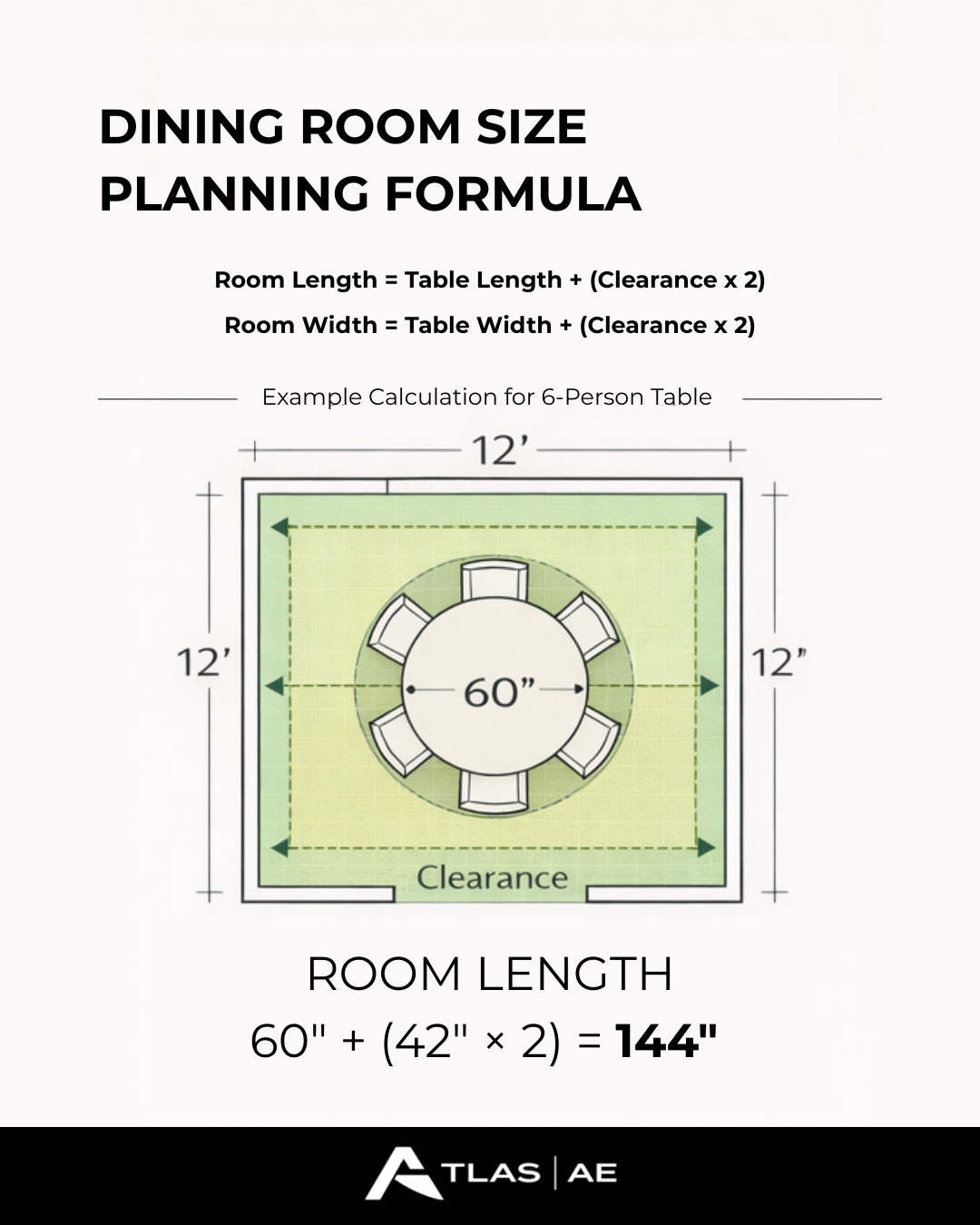
Dining Room Size Planning Formula
Why This Formula Matters
Most dining room planning mistakes happen because homeowners:
Choose the table first
Assume clearance will “work itself out”
Forget to account for chair depth
Ignore cross-traffic
By using the formula early, you prevent overcrowding before furniture is purchased.
It shifts planning from reactive to intentional.
Average Dining Room Size in Feet (Quick Summary)
If you want a fast reference for common configurations, here’s how most residential dining rooms scale in real-world planning:
6-person dining room: 12’ × 12’ (minimum functional)
8-person dining room: 14’ × 16’ (balanced and comfortable)
Large entertaining space: 16’ × 18’ or larger
Minimum clearance around table: 36–42 inches
But remember — square footage alone does not define quality.
A 14’ × 16’ room can feel tight if clearance drops below 36”.
A 12’ × 12’ room can feel balanced if circulation is handled intelligently.
Planning Checklist
Before finalizing your dining room size, confirm:
Does the table support 24–30 inches per person?
Is there at least 42 inches of circulation on primary sides?
Does ceiling height match table scale?
Is cross-traffic accounted for in open layouts?
Is there room for secondary furniture without compressing clearance?
If the answer to any of these is no, adjust the layout before purchasing furniture.
Conclusion
The average dining room size isn’t just about fitting a table. It’s about circulation, proportion, comfort, and how the space integrates with your home.
When you apply professional clearance standards and realistic table dimensions, you eliminate guesswork and avoid costly layout mistakes, with our comprehensive architectural planning services guiding every stage of a home renovation or new build.
If you're planning a renovation or new build, use this guide as your reference framework — and share it with anyone who needs clarity before making decisions.
For more architectural planning insights, explore our related resources at AtlasAE.
