What Is Commercial Architecture?
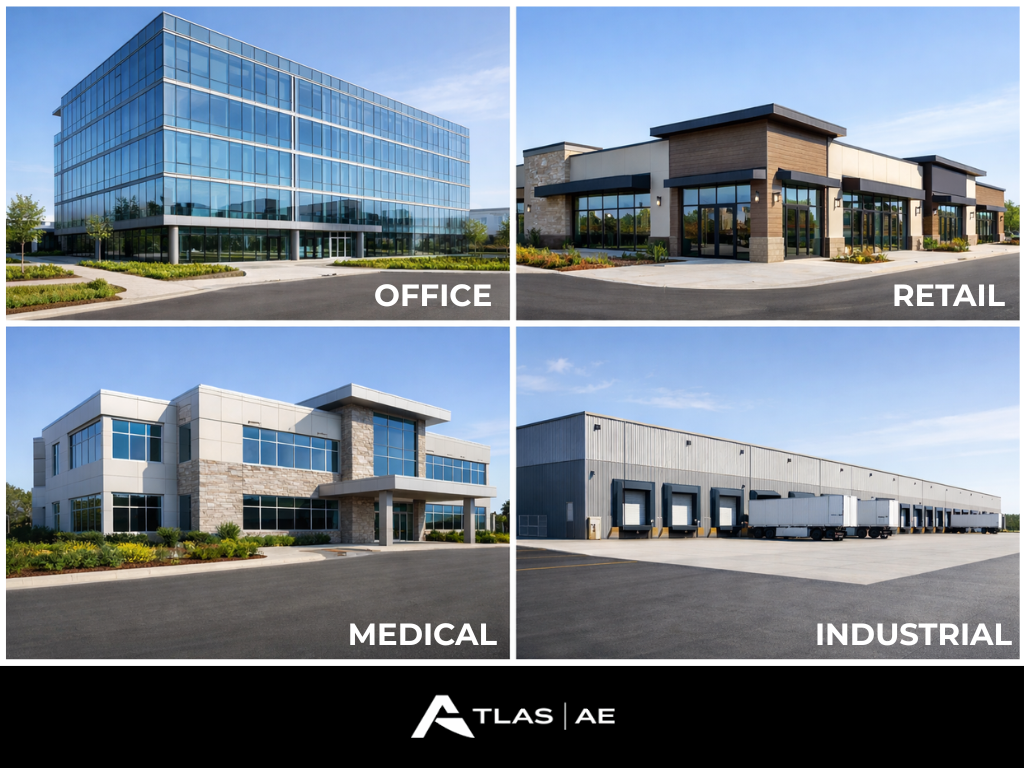
Commercial architecture is the professional design of buildings used for business, institutional, or public purposes. It shapes the offices where teams work, the restaurants where people gather, the medical facilities that deliver care, and the industrial buildings that power supply chains.
At its core, what is commercial architecture? It is the discipline focused on creating structures that enable commerce at scale. Unlike residential design, which serves private living environments, commercial architecture must accommodate higher occupancy loads, stricter life-safety regulations, accessibility compliance, and complex mechanical systems. It is not simply a larger version of home design. It is a discipline defined by regulation, operational efficiency, and public responsibility.
Understanding what commercial architecture truly means requires looking beyond appearance. These buildings must perform — structurally, financially, and operationally — for decades.
What Is Commercial Architecture? A Practical Definition
When someone searches for what is commercial architecture, they are often trying to understand how it differs from designing houses. The answer lies in purpose, scale, and liability.
Commercial architecture refers to the design of structures used for commerce, services, or public interaction. These typically include:
Office buildings
Retail stores and shopping centers
Restaurants and hospitality venues
Medical and dental facilities
Warehouses and industrial buildings
Mixed-use developments combining multiple functions
The defining factor is occupancy and code classification. A single-family residence might house five people. A commercial building of similar size could legally accommodate dozens or hundreds. That increase in occupancy changes everything — from structural design to fire protection to mechanical ventilation.
Commercial buildings must comply with the International Building Code (IBC), state amendments, fire safety standards, and accessibility laws such as the Americans with Disabilities Act of 1990. These regulations directly shape the building’s layout, materials, and systems.
What Does a Commercial Architect Do?
To fully answer what does a commercial architect do, you need to understand the entire project lifecycle. A commercial architect is not just a designer. They are a strategist, technical coordinator, and regulatory navigator.
Their responsibilities begin before design starts.
Pre-Design and Feasibility
Before drawings are produced, a commercial architect evaluates whether the project is viable. This stage typically includes:
Zoning and land-use analysis
Building code classification review
Parking and traffic requirement evaluation
Flood zone and environmental constraints
Preliminary budget alignment
Many business owners make the mistake of signing leases or purchasing property without this step. Early feasibility analysis prevents costly redesign and compliance issue.
Design and Operational Planning
Once feasibility is confirmed, the architect develops the building concept and layout. In commercial architecture, design is directly tied to business operations.
Retail layouts influence customer movement and purchasing behavior. Office circulation impacts collaboration and productivity. Restaurant planning determines service speed and kitchen efficiency. Medical facilities require privacy, infection control considerations, and precise adjacencies.
Commercial architects translate business goals into spatial strategy.
Life-Safety and Accessibility Integration
Commercial buildings serve the public. That responsibility introduces strict life-safety requirements.
Architects must integrate:
Egress systems sized for occupancy load
Fire-rated walls and assemblies
Sprinkler and alarm coordination
ADA-compliant entrances and restrooms
Continuous accessible paths of travel
These are legal requirements tied to public safety and liability, not optional upgrades.
Technical Systems Coordination
Commercial projects involve complex building systems that require coordination across disciplines.
Architects work alongside engineers to integrate:
Structural systems such as steel frames or reinforced concrete
Mechanical systems designed for high occupancy loads
Electrical distribution and emergency power
Commercial plumbing systems
Energy code compliance strategies
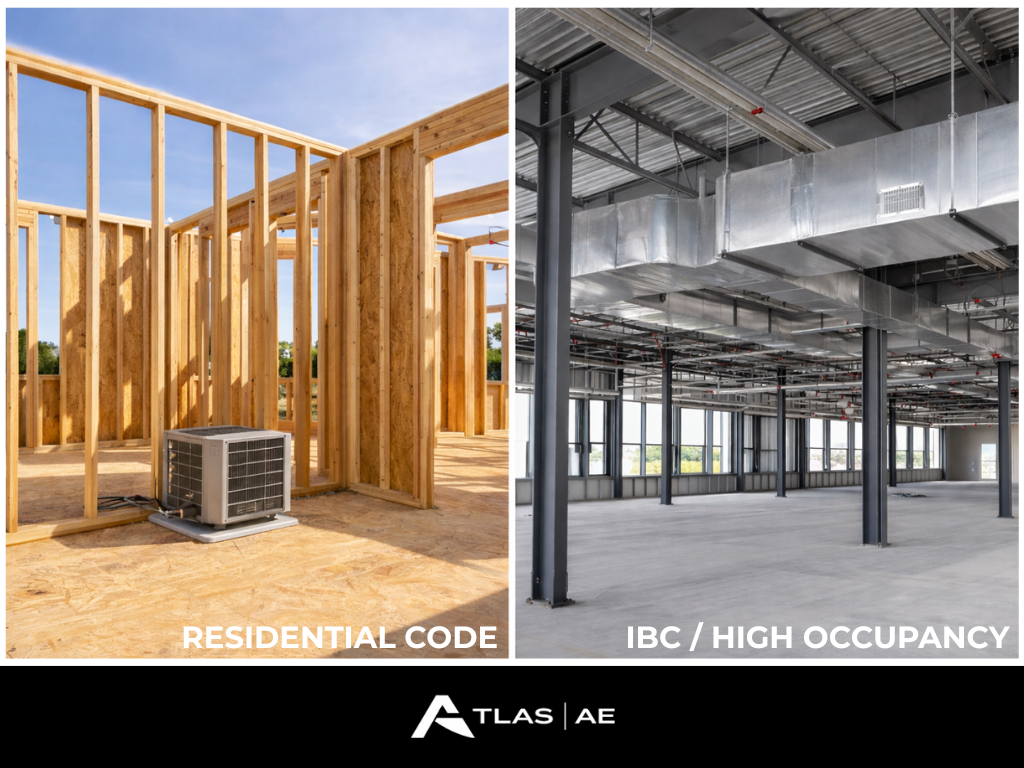
Unlike residential buildings that often use wood framing and simplified HVAC systems, commercial structures typically rely on more durable structural systems and advanced mechanical networks designed for long-term performance.
Permitting and Regulatory Navigation
Commercial permitting is layered and technical. Projects often require review from multiple authorities, including building departments, planning boards, zoning boards, and fire officials.
In states like New Jersey, additional considerations may include floodplain regulations, density controls, and redevelopment zone standards. The architect prepares documentation, responds to plan review comments, and coordinates revisions to secure approval.
Construction Administration
Even after permits are issued, the architect remains actively involved. During construction, they:
Conduct site visits
Review contractor submittals
Respond to Requests for Information (RFIs)
Clarify design intent
Monitor compliance with approved plans
This oversight protects the owner’s investment and ensures the building is constructed as intended.
Difference Between Residential and Commercial Architecture
One of the most common misconceptions is that commercial architecture is simply residential architecture on a larger scale. The reality is far more technical.
Below is a clear comparison highlighting the difference between residential and commercial architecture.
| Factor | Residential Architecture | Commercial Architecture |
|---|---|---|
| Scale | Limited occupancy | High occupancy |
| Codes | Residential code | Commercial building code |
| Life Safety | Basic fire separation | Advanced fire protection systems |
| Accessibility | Limited ADA application | Full ADA compliance required |
| Structural Systems | Wood framing common | Steel, concrete, long-span systems |
| Mechanical Systems | Basic HVAC | Complex MEP systems |
| Permitting | Simplified review | Multi-layer regulatory review |
| Liability | Private risk | Public risk exposure |
Residential architecture prioritizes comfort and lifestyle. Commercial architecture prioritizes safety, compliance, durability, and operational performance.
Public liability significantly increases the design complexity. Commercial buildings must anticipate crowd movement, emergency evacuation scenarios, equipment loads, and inspection requirements that rarely apply to private homes.
Why Commercial Architecture Is More Complex
Commercial architecture involves greater complexity for several interconnected reasons.
First, occupancy classifications under the International Building Code dictate fire ratings, exit requirements, and structural loads. Each building type — retail, assembly, industrial, healthcare — carries unique compliance obligations.
Second, fire protection systems are mandatory in most commercial buildings. These include sprinkler systems, fire alarms, rated corridors, and smoke control strategies.
Third, egress systems must be calculated based on occupant load. Exit width, travel distance, and stair capacity are all determined mathematically by code.
Fourth, mechanical ventilation standards are more demanding. Restaurants, healthcare facilities, and assembly spaces require specific airflow rates to maintain public health standards.
Fifth, structural loads are significantly higher. Commercial floors must support greater live loads and longer spans than typical residential construction.
Finally, site design adds another layer of complexity. Municipalities often require:
Minimum parking ratios based on square footage
Traffic circulation studies
Stormwater management systems
Landscaping buffers
Each requirement affects cost, schedule, and building layout.
Commercial Architecture in New Jersey
Commercial architecture in New Jersey presents additional regulatory and environmental challenges. Projects must comply with the NJ Uniform Construction Code, which incorporates the International Building Code along with state-specific amendments.
Flood zone regulations are especially relevant in coastal and river-adjacent areas. Elevation mandates can influence foundation systems and finished floor heights. Planning board and zoning board approvals are frequently required for site development, particularly in mixed-use or redevelopment zones.
New Jersey’s growth in logistics and warehouse development has increased demand for industrial buildings designed for heavy truck access, large structural spans, and high-capacity floor systems. At the same time, urban mixed-use development continues to expand in key corridors, requiring thoughtful integration of residential and commercial functions.
Understanding these regional considerations early reduces risk and shortens approval timelines.
When Do You Need a Commercial Architect?
Many business owners wait too long to involve an architecture firm. In reality, early consultation provides the most value.
You should engage a commercial architect if you are:
Opening a new retail or restaurant location
Expanding office space
Renovating a commercial interior
Converting a building to a new use
Developing medical facilities
Constructing warehouse or industrial space
Even tenant fit-outs can trigger code upgrades, accessibility requirements, or occupancy reclassification. Early architectural guidance helps identify these issues before they become costly surprises.
Conclusion
Commercial architecture is not scaled-up residential design. It is a specialized discipline that answers the question, what is commercial architecture? — a field requiring regulatory expertise, systems coordination, operational planning, and public safety integration.
From occupancy classifications and fire protection to mechanical systems and zoning approvals, commercial projects demand precision and foresight. The complexity exists because these buildings serve the public and must perform reliably for years.
For businesses planning a new workspace or office renovation, consulting an experienced office architect in NJ ensures your design meets code, supports productivity, and reflects your brand. Engaging a skilled architecture firm early in the process helps reduce uncertainty, protect your investment, and guide your project from concept to completion.
